Candle Frosting: What It Is, Why It Happens, and How to Fix It
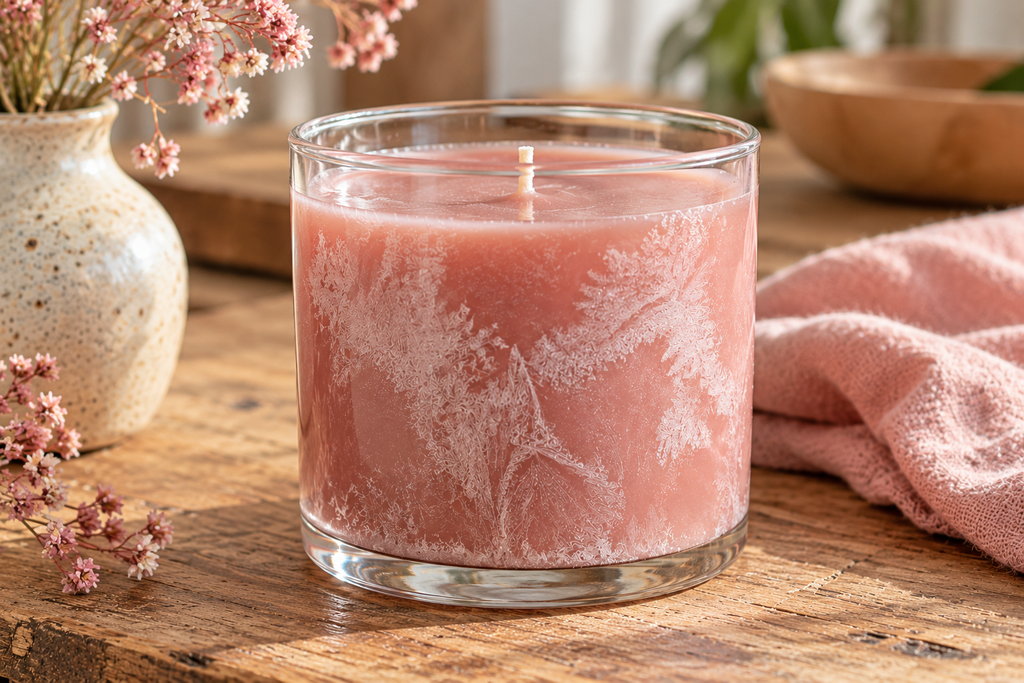
You did everything right. You measured the wax, hovered over the thermometer, poured with the steady hands of a surgeon, and the next morning your candle looks like it got caught in a tiny snowstorm.
Welcome to candle frosting: the white, crystal-like film that shows up on natural wax candles and turns a smooth, glossy finish into something resembling powdered sugar. It’s one of the most common (and most annoying) problems candle makers run into, especially with soy wax.
The good news is that it’s rarely your fault, and it doesn’t mean you’ve ruined the batch. In this guide, we’ll cover what frosting actually is, why it happens, how to lower your chances of seeing it, and how to fix it when it shows up anyway. We’ll also tackle the bigger question: is it really a flaw at all?
By the end, you’ll know exactly what’s happening inside your wax and what to do about it.
What Is Candle Frosting?
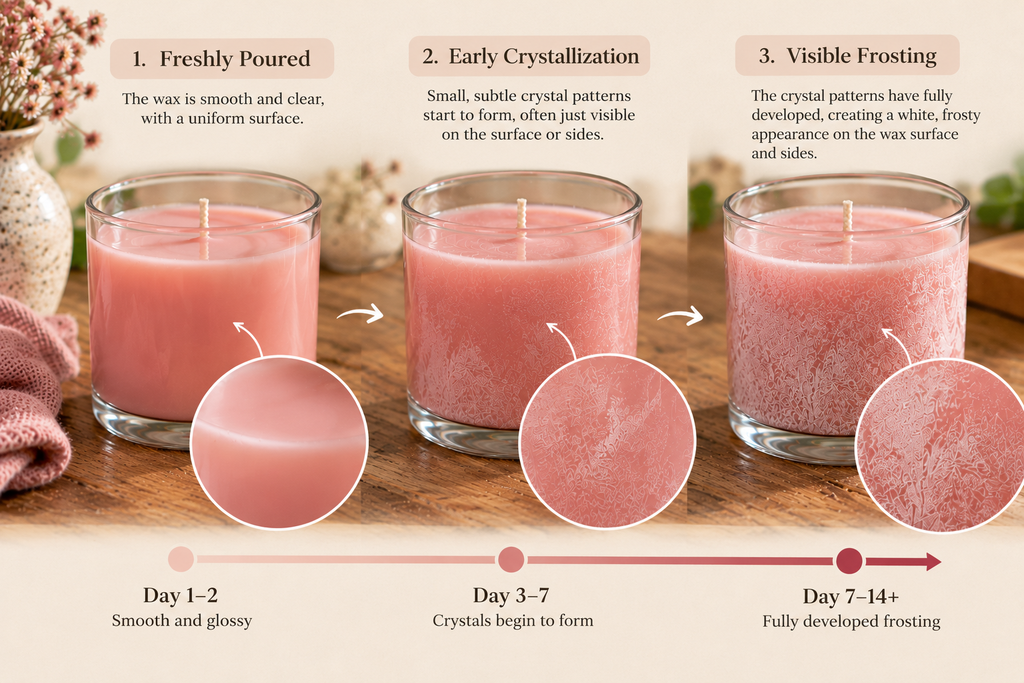
Candle frosting is a white, powdery or crystalline coating that appears on the surface or along the sides of a candle, usually after the wax has set. It can show up either as a light hazy film, scattered patches, or delicate feathery patterns that look a lot like frost on a window, which is where the name comes from. It’s most noticeable on dyed candles and in clear glass containers, where the contrast makes it hard to miss.
The scientific term for what’s happening is polymorphism: the ability of a substance to crystallize in more than one form. Natural waxes, like soy, are made of fats that naturally settle into their most stable crystal structure. As the wax cools and ages, those fats gradually rearrange themselves into visible crystals, and that’s the frosting you see on the surface. It can appear within hours of pouring, or creep in weeks later.
Here’s the most important thing to know up front: frosting is purely cosmetic. It doesn’t change how your candle burns, how it smells, or how safe it is to use. Once the candle is lit and the top layer melts, the crystals simply melt away with it.
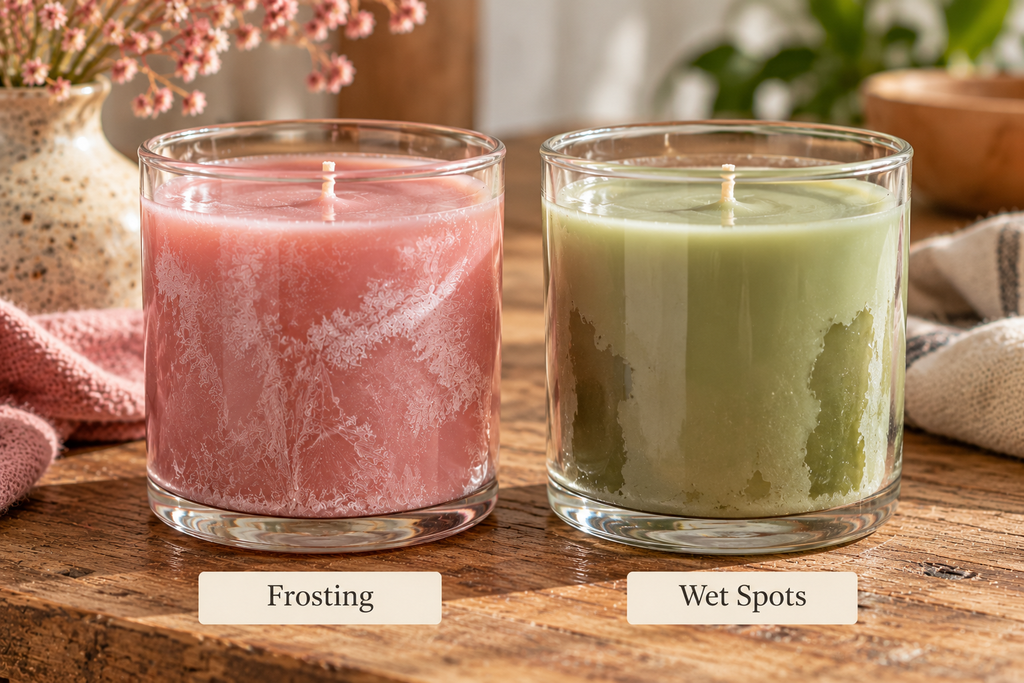
One quick distinction: frosting is often confused with wet spots, those dark, patchy areas where the wax pulls away from the glass. They can look similar at a glance, but wet spots are a separate adhesion issue with different causes and fixes.
Why Does Frosting Happen?
Frosting comes down to how natural waxes are built. Soy wax is made from hydrogenated soybean oil, which is a mix of fats, and fats rarely stay put. When the wax cools, it solidifies quickly, but not always into its most stable crystal arrangement. Over time, the molecules keep rearranging toward that stable form, and as they do, they grow into larger crystals that scatter light and look white. In other words, the wax is still settling into its natural structure long after it looks finished.
That’s why frosting isn’t a sign of a bad batch or a defective wax. Crystals keep forming slowly even when you can’t see them, so a candle that looks flawless on day one can still frost weeks later.
Which Waxes Are Most Prone to Frosting?
Not every wax behaves the same way, and the difference comes down to the type:
- Soy wax: The most common offender, especially 100% soy wax with no additives. Many commercial soy blends include stabilizers designed to slow crystal growth, which is why some soy candles frost far less than others.
- Palm wax: Naturally crystalline. In fact, its feathery, snowflake-like patterns are a feature rather than a flaw, and some makers choose palm wax specifically for that look.
- Other vegetable wax blends: Results vary. Blends that include coconut wax or other additives tend to frost less than pure soy.
- Paraffin wax: Rarely frosts. Because it’s a refined, petroleum-based wax with a more uniform and stable structure, its crystals usually don’t keep shifting after it sets.
Frosting vs. Bloom
If you’ve read our beeswax guide, this might sound familiar. Beeswax has its own version of the same visual effect, called bloom: a pale, powdery film that develops on the surface as the wax ages. The two look alike and are both harmless, and you’ll sometimes see the terms used interchangeably. By convention, though, ‘bloom’ is used mostly for beeswax and ‘frosting’ for plant-based waxes like soy
What Triggers Frosting in Candles?
Frosting is natural, but how much you get, and how fast it appears, depends on a handful of factors you can influence. Here are the main ones.
Wax type
Pure, additive-free soy wax frosts the most. Blends that include coconut wax, paraffin, or other stabilizers tend to crystallize more slowly, which is why changing the wax itself is often the most effective fix.
Pouring temperature
Pouring too hot or too cold can both make frosting worse, and the ideal temperature depends on the specific wax. Many soy waxes pour well somewhere around 120-140°F (49-60°C), but some blends are formulated for noticeably higher or lower pours, so your supplier’s recommended range is always the best starting point.
Cooling speed
This is the big one. When wax cools too quickly or unevenly, crystals form unevenly too. Cold rooms, drafts, and cold work surfaces all speed things up, and so does the old trick of putting candles in the fridge or freezer to set faster. Slow, steady cooling gives you the smoothest finish.
Room and storage temperature
Frosting isn’t decided only while the candle sets. Soy wax keeps slowly reorganizing its crystal structure for weeks afterward, and temperature controls how fast that happens. Each time a candle warms slightly and cools again, the fat molecules in the wax gain just enough mobility to rearrange into larger, more stable crystals, and larger crystals are the ones that show up as visible frosting.
That’s why a candle kept at a steady, moderate temperature (roughly 18-25°C / 64-77°F) tends to stay smooth for longer than one that goes through repeated warm-and-cool cycles, whether that happens during shipping or in storage.
A room that’s too cold while the candle sets causes problems of its own. We cover this in more detail in our guide to candle making in cold weather.
Over-stirring
Stirring the melted wax more than necessary can encourage crystal formation. Mix thoroughly enough to blend in fragrance and dye, then stop.
Fragrance and dye
Dye doesn’t cause frosting, but it makes it far more visible, since white crystals stand out sharply against deeper colors. Fragrance oils can influence how the wax sets, though the effect varies by oil and by wax, which makes it harder to predict.
Age and light
Wax keeps crystallizing slowly over time, so frosting becomes more likely the longer wax or a finished candle has been sitting around, even if it looked flawless at first. Prolonged exposure to light and heat can speed this up, so it helps to use fresh wax and keep finished candles out of direct sunlight and away from heat sources.
Most of these are things you can adjust, which is good news, because the next section is all about how.
How to Prevent Frosting
Since you can’t switch frosting off entirely (not with pure soy, anyway), the goal is to slow it down and keep it as subtle as possible. These are the steps that make the biggest difference.
Follow your wax’s pouring range
Start with your supplier’s recommended pouring temperature, then adjust in small steps of about 5°F (3°C) between batches. Because the ideal temperature varies from wax to wax, a few test pours will teach you more than any universal number. Keep notes on each batch so you can spot the temperature that gives you the smoothest finish.
Preheat your containers
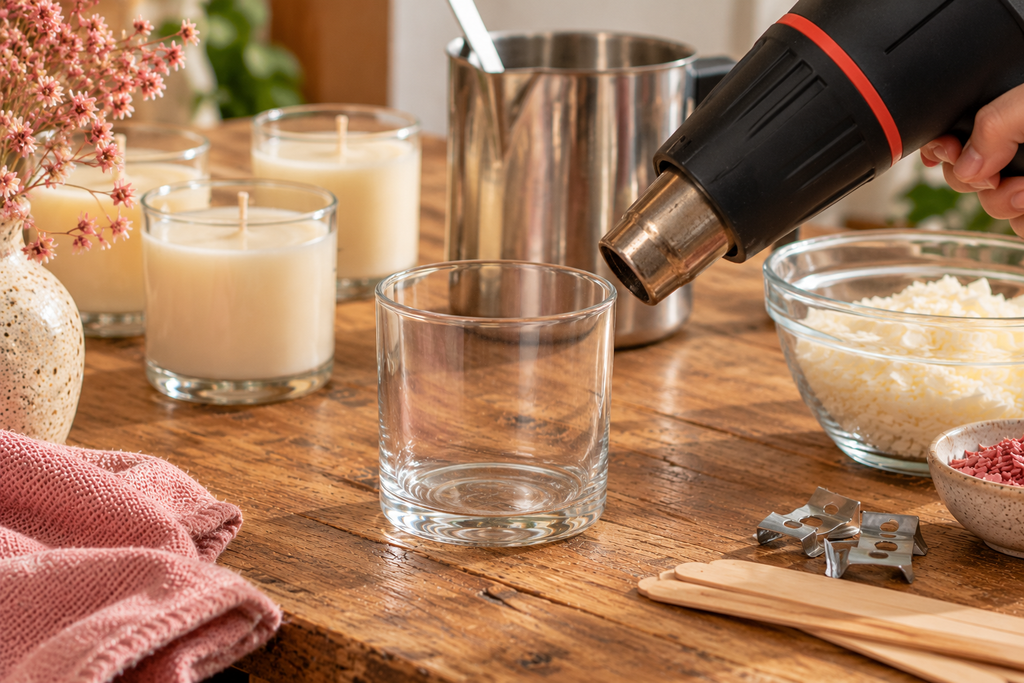
A cold jar pulls heat out of the wax along the glass, which causes the sides to cool faster than the center and invites frosting. Warming your containers first evens out the cooling. A low oven works well, and you only need the glass comfortably warm: around 100-110°F (38-43°C) is plenty. A heat gun passed briefly over the glass does the same job. Handle warm jars with care, and never use anything near boiling temperature.
Cool slowly, in a steady environment
Let your candles set somewhere draft-free and at a stable room temperature, away from cold surfaces, fans, and open windows. Setting jars on a towel or piece of cardboard keeps them from losing heat through the bottom, and placing a cardboard box loosely over them slows cooling even more. Resist the urge to speed things up in the fridge or freezer, since that sudden temperature drop is one of the surest ways to get frosting.
Go easy on the stirring
Stir long enough to blend fragrance and dye fully, then stop. Extra stirring doesn’t improve the candle, and it can encourage crystal formation.
Let candles cure and store them steadily
Soy candles benefit from a curing period of about a week or two, which also helps fragrance bind to the wax. Keep them somewhere with a consistent, moderate temperature while they cure, and avoid dramatic swings afterward, including during shipping, since those warm-and-cool cycles are what keep frosting coming back.
Try a blend or an additive
If frosting really bothers you, the most reliable lever is the wax itself. Soy blends that include coconut wax or paraffin crystallise more slowly than pure soy, and many makers find that wax hardeners like stearic acid help improve the finish. Results vary, so test small batches first, and keep in mind that many pre-blended soy waxes already contain additives, so adding more may do little.
A UV inhibitor can also help protect candles from light-related changes. Follow the manufacturer’s dosage instructions, since recommendations differ between products. None of these will eliminate frosting completely, because the soy itself is still doing what soy does.
Choose your container and color wisely
If you’ve done everything right and still see frost, presentation is your last line of defense. Opaque containers hide it entirely, and lighter or undyed wax shows it far less than deep, saturated colors, where white crystals stand out the most.
How to Fix Frosting After It Happens
Good news: if frosting has already shown up, you have options. Just keep one thing in mind going in: most fixes are temporary. Because the wax keeps crystallizing slowly over time, frosting that disappears today can creep back later. Think of these methods as touch-ups rather than cures.
The heat gun method
A heat gun is the go-to tool for most candle makers, and it works because wax crystals respond to heat. Warm the surface just enough and the wax relaxes back into a smooth, glossy layer.
- Set the heat gun to low and hold it a few inches from the candle, never directly against it.
- Warm the top first. Move in slow, steady circles until the surface turns glossy and the frosting fades, then stop. You only want to soften the top layer, not melt through it.
- Warm the sides gently. For frosting along the glass, sweep the heat gun back and forth across the outside of the jar. Keep it moving the whole time, since heat concentrated in one spot can overheat the wax or stress the glass.
- Let the candle set undisturbed in a draft-free spot, so it cools slowly and evenly. A hair dryer can work in a pinch, though its wider airflow can blow hot wax around, so work carefully. And always make sure your containers are made to handle heat. Ordinary drinking glasses or decorative bottles aren’t built for sudden temperature changes and might crack.

We’ve put together a roundup of the best 5 heat guns for candle making. If you’re still browsing the market to choose the best heat gun for your candle business, check it out.
Hiding it instead
If frosting keeps coming back, you can also work around it. Opaque, colored, or textured containers all camouflage it, and so does a well-placed label. For candles you sell, a short note explaining that frosting is a natural trait of plant-based wax can turn a perceived flaw into a selling point.
Is Frosting Actually a Bad Thing?
Short answer: no. After everything we’ve covered, it’s worth stepping back, because frosting looks like a problem far more than it acts like one. It has most of the time no effect on how your candle burns, how it smells, or how safe it is, and the only thing it changes is the first impression.
Plenty of candle makers see it differently once they understand where it comes from. Frosting is a natural trait of plant-based waxes, and a candle that stays flawless forever often owes that to additives, blends, or a different base wax. That doesn’t make those candles worse, but it does mean a little frost is a normal sign of a natural wax behaving like it should.
The one real challenge is perception. Customers who have never heard of frosting can mistake it for mold, dust, or a defect, and that’s where a quick explanation helps, whether it’s a line on your label, a note on your product page or a few words at a market stall.
Once people know what they’re looking at, the concern usually fades.
So aim for the smoothest finish you can get, but don’t lose sleep over the occasional frosty candle. It’s a cosmetic quirk, not a flaw in your craft.
Frequently Asked Questions (FAQ)
Does frosting affect how a candle burns or smells?
No. Frosting stays on the surface, so the wax underneath remains unchanged. You can see this on the first burn: as the melt pool forms, the crystals dissolve back into the wax, and the candle burns normally.
Is it frosting or mold?
Frosting is dry, powdery, or crystalline. Mold would look fuzzy, raised, and patchy, and it may smell musty. It’s also very rare on wax, which offers little for mold to feed on. If you’re unsure, gently warm a small spot: frosting fades, mold doesn’t.
Will frosting come back after I fix it?
Often, yes. A heat gun melts the crystals, but the wax keeps crystallizing slowly, so frosting can return within days or weeks. That’s why it’s best to fix candles close to the moment you photograph, gift, or sell them.
Does frosting mean a candle is 100% soy?
Not necessarily. Frosting is a common sign of natural wax, but it isn’t proof, since other plant-based waxes like palm frost too. Blends and stabilizers can also reduce or prevent it, and even pure soy sometimes stays smooth, so a lack of frosting doesn’t tell you what’s in the jar either.
Why did only some candles from the same batch frost?
Frosting is unpredictable. Small differences in how each jar cooled, such as its spot on the table, a nearby draft, or how close it sat to its neighbors, can be enough to tip one candle into frosting while another stays smooth.
Does humidity cause frosting?
There’s no solid evidence that humidity directly causes frosting, though some suppliers recommend a warm, dry, draft-free room for curing as general good practice.
Final Thoughts
Frosting has a talent for appearing right after you’ve finished admiring a flawless candle. But now you know what’s behind it: a bit of natural crystal growth, no harm done, and plenty of ways to keep it under control.
Pour at the right temperature, cool your candles slowly, keep their environment steady, and keep a heat gun within reach for the occasional touch-up.
Thanks for reading, and we hope this guide helped you understand your wax a little better. Leave a comment and let us know what you think!
One Comment