What Is Paraffin Wax? How It’s Made, Its Uses & Why It’s Controversial

If you’ve spent any time researching candle making, you’ve probably come across paraffin wax.
It is one of the oldest and most widely used candle waxes, and it is also one of the most debated. Some candle makers love it for its strong fragrance performance, smooth appearance and versatility. Others avoid it because it is derived from petroleum.
And then there are all the claims surrounding paraffin toxicity, that it produces dangerous chemicals when burned, or that it is inherently worse for indoor air than plant-based waxes.
So what is actually true?
In this guide, we’re going to look at what paraffin wax is, where it comes from, how it is refined, how it performs in candles, its advantages and disadvantages, and — most importantly — what scientific research has found about the controversy surrounding it.
What Is Paraffin Wax?
Paraffin wax is a petroleum-derived wax made primarily of long-chain hydrocarbon molecules.
At room temperature, it is generally a white or translucent solid with little to no odor. Different paraffin waxes can have very different properties depending on their composition, melting range, oil content and degree of refinement.
And this is important: when we say “paraffin wax,” we’re not necessarily talking about one identical material.
Paraffin is available in different grades and formulations, and candle makers can buy waxes specifically designed for containers, pillars, votives, wax melts and other applications.
For candle making, the paraffin you’ll normally encounter from a reputable candle supplier is refined paraffin wax, rather than some crude petroleum oil.
Where Does Paraffin Wax Come From?
The short answer is: petroleum.
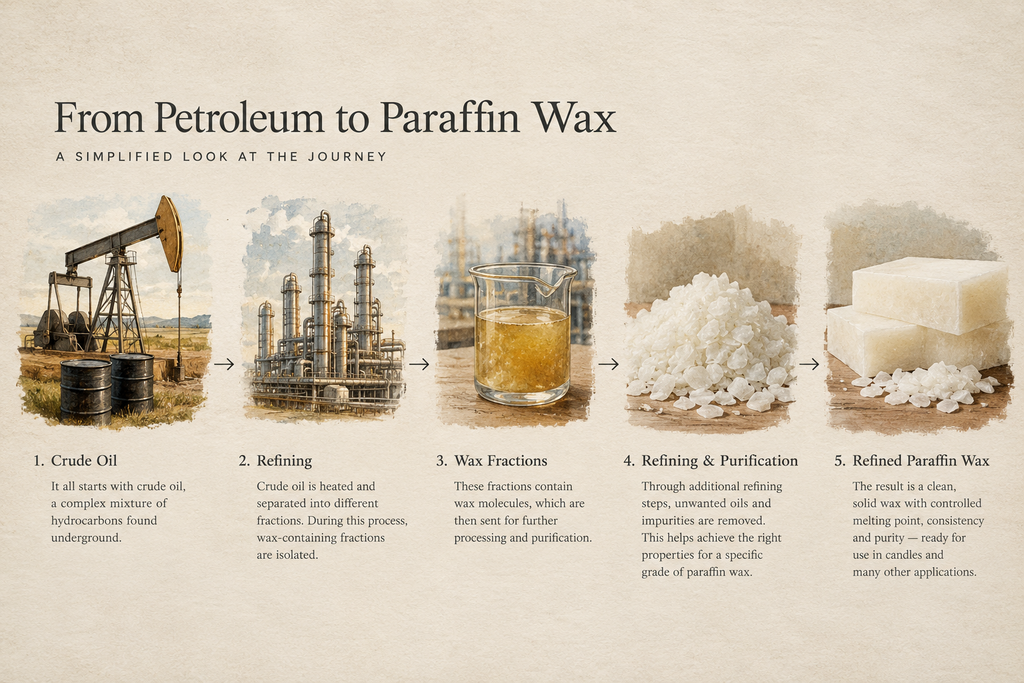
Crude oil contains a huge mixture of different hydrocarbons. During petroleum refining, these components are separated and processed into different materials.
Some wax-containing fractions can eventually be processed into paraffin wax.
The wax then undergoes additional refining and purification to remove unwanted oil and other compounds and achieve the characteristics required for a particular grade.
So although paraffin starts with petroleum, there are several steps between crude oil coming out of the ground and the clean, solid wax you buy for candle making.
And that brings us to the next question.
How Is Paraffin Wax Made?
The exact industrial process can vary depending on the type of wax being produced, but the basic idea is relatively simple.
During petroleum refining, wax-containing fractions are separated from the other components of crude oil. These waxes can then go through additional processing to remove excess oil and impurities and to control properties such as color and consistency.
Further refining can produce different grades of paraffin with different characteristics, different melting points, hardnesses and intended applications rather than one universal “paraffin wax.”
What Is Fully Refined Paraffin Wax?
You’ll often see the term fully refined paraffin wax when shopping for candle supplies.
Fully refined paraffin has undergone additional purification to reduce residual oil content and improve consistency, color and other properties.
For example, ExxonMobil’s fully refined paraffin grades (like Prowaxx) have maximum oil contents in the range of about 0.5–0.7%, depending on the specific grade.
This is very different from less-refined petroleum waxes.
Some petroleum waxes can contain considerably more residual oil and have different physical characteristics. The degree of refining therefore matters when discussing the properties — and especially the safety claims — surrounding paraffin wax.
“Petroleum-derived” doesn’t tell you everything about a wax. Its degree of refinement matters a lot too.
What Does Paraffin Wax Look and Feel Like?
Fully refined paraffin is usually either white, translucent or nearly colorless in its solid form, although its exact appearance can vary between grades.
It is generally smooth and relatively firm, but again, not all paraffin behaves the same way. Some grades are softer and designed for container candles, while others are harder and formulated for pillars, votives or molded candles.
This might sound like a boring technical detail, but it actually matters a lot when you’re making candles: A wax that works beautifully in a jar isn’t necessarily going to behave well when you pour it into a pillar mold.
That’s one of the biggest things to remember about paraffin:
There isn’t just one paraffin wax.

Why Do Candle Makers Use Paraffin Wax?
Paraffin has been used in candle making for a very long time, and there’s a reason it has stuck around.
It can offer:
- strong fragrance performance
- excellent color possibilities
- consistent results
- good mold release
- different grades for different candle types
- versatility across containers, pillars, votives and melts
And while soy wax, beeswax, coconut wax and other alternatives have become increasingly popular, paraffin hasn’t suddenly become useless. In fact, for some candle makers, its performance characteristics are exactly what they’re looking for.
If you’re curious about how another popular candle wax compares, you can also check out our Comprehensive Guide on Soy Wax.
Strong Fragrance Performance
One of the reasons paraffin is popular with candle makers is its reputation for strong fragrance performance.
Paraffin can accommodate relatively high fragrance loads, although the appropriate amount depends on the specific wax, fragrance oil and overall candle formulation. Different candle-wax suppliers list paraffin formulations with fragrance capacities that can be quite high.
This doesn’t mean that adding more fragrance automatically gives you a better candle.
In fact, more fragrance isn’t always better. The wax, fragrance oil, wick and overall formulation all need to work together.
But when properly formulated, paraffin is well known for producing a strong hot throw — the scent you notice while the candle is burning.
Paraffin Wax & Colors
Another advantage of paraffin is its ability to provide a relatively clean base for candle dyes.
Fully refined paraffin is generally very light in color, so it doesn’t compete much with the dye you’re adding. This can make it particularly useful if you’re making brightly colored candles or experimenting with different shades.
And if you’re making decorative or molded candles, that can be a pretty big advantage.
Paraffin Wax Is Consistent
Commercial paraffin grades can be tightly controlled for properties such as melting point, oil content and molecular composition.
That consistency can make the wax relatively predictable from batch to batch.
For candle makers, this matters. You don’t necessarily want your wax behaving completely differently every time you make a new batch of candles.
Current technical information from ExxonMobil, for example, describes controlled molecular composition and low oil content as characteristics that support consistent formulation and candle-making flexibility.
Of course, your results will still depend on your specific wax, fragrance, wick and process.
But the underlying material can be quite consistent.
What Can You Make With Paraffin Wax?
Quite a lot.
Depending on the specific formulation, paraffin wax can be used for:
- container candles
- pillar candles
- votives
- tealights
- molded and decorative candles
- wax melts
- tapers and other sculptural candles
Container candles
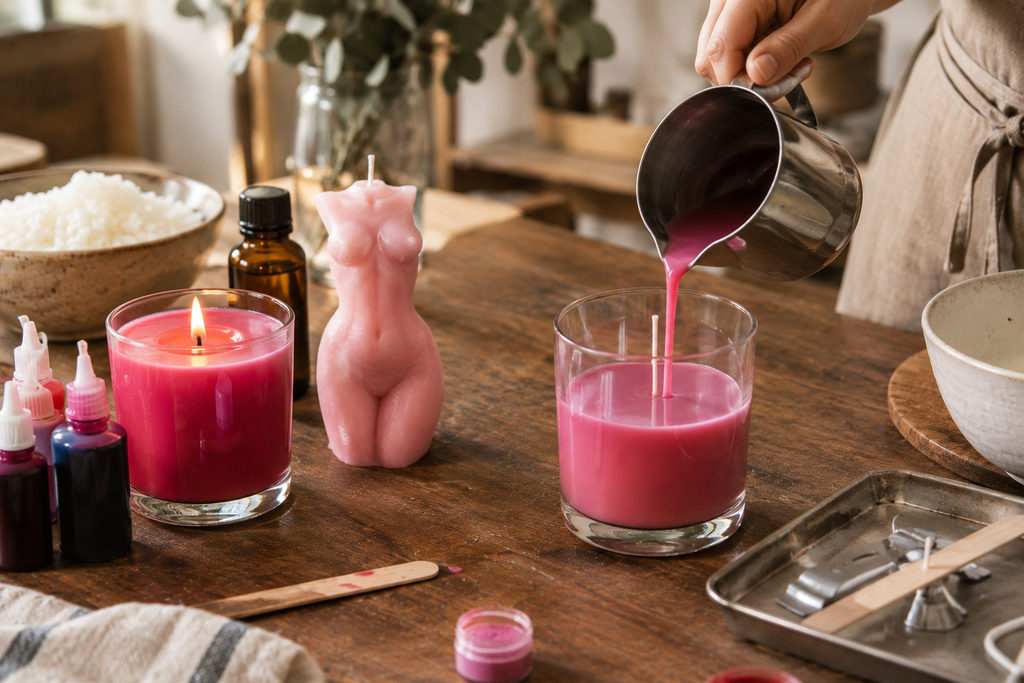
Container paraffin wax is generally formulated to work inside jars and other vessels. These waxes are usually softer and designed with properties that help them perform appropriately in a container.
Pillar candles
Pillar paraffin wax needs to be firm enough to hold its shape once removed from the mold.
Some fully refined paraffin grades are specifically listed for votive and pillar candle applications, while other grades are designed for containers or other uses.
The important part is choosing a paraffin formulation designed for your specific candle project.
What Is Paraffin Wax Used For Besides Candles?
Candles are probably the use you’ll encounter most often as a candle maker, but paraffin has plenty of other applications.
Depending on the grade, paraffin wax can be used in things such as:
- paper and packaging coatings
- cosmetics and personal-care products
- Polishes (like shoes polish)
- crayons
- adhesives
- wax blends and emulsions
- industrial applications
Its ability to provide properties such as water resistance, gloss and consistency makes it useful far beyond candle making.
So no, paraffin did not spend the last two centuries sitting around waiting for someone to put a wick in it.
Does Paraffin Wax Have Any Disadvantages?
But a comprehensive look at paraffin also means being honest about where it falls short.
The biggest issue is pretty obvious:
It’s petroleum-derived.
Petroleum is a non-renewable resource, so paraffin isn’t a renewable plant-based wax.
There are also some overall practical considerations:
Some paraffin candles can shrink during cooling, which can sometimes create challenges when working with certain containers or molds.
And because paraffin isn’t one single formulation, two different paraffin waxes can behave quite differently.
So while paraffin can be very predictable within a particular formulation, you shouldn’t assume that everything labeled “paraffin” will behave exactly the same way.
Why Is Paraffin Wax Controversial?
Search for “paraffin wax” online and you’ll quickly find claims that paraffin candles are toxic or that burning them releases dangerous chemicals into your home.
You’ll also find people arguing that soy, beeswax or other natural waxes are automatically cleaner and safer.
The problem is that these conversations often mix together several different questions:
Where does the wax come from?
How refined is it?
What happens when the candle burns?
How much soot does it produce?
Does the wax type itself determine the safety of the candle?
So, let’s look at what has actually been studied.
Is Paraffin Wax Toxic?
The safety of paraffin as a refined material and the emissions produced when a paraffin candle burns are two different subjects.
A candle is a combustion system.
Once you light a candle, you’re no longer simply dealing with a piece of wax. The wick, flame, fragrance, dye, airflow and burning conditions all become part of the picture.
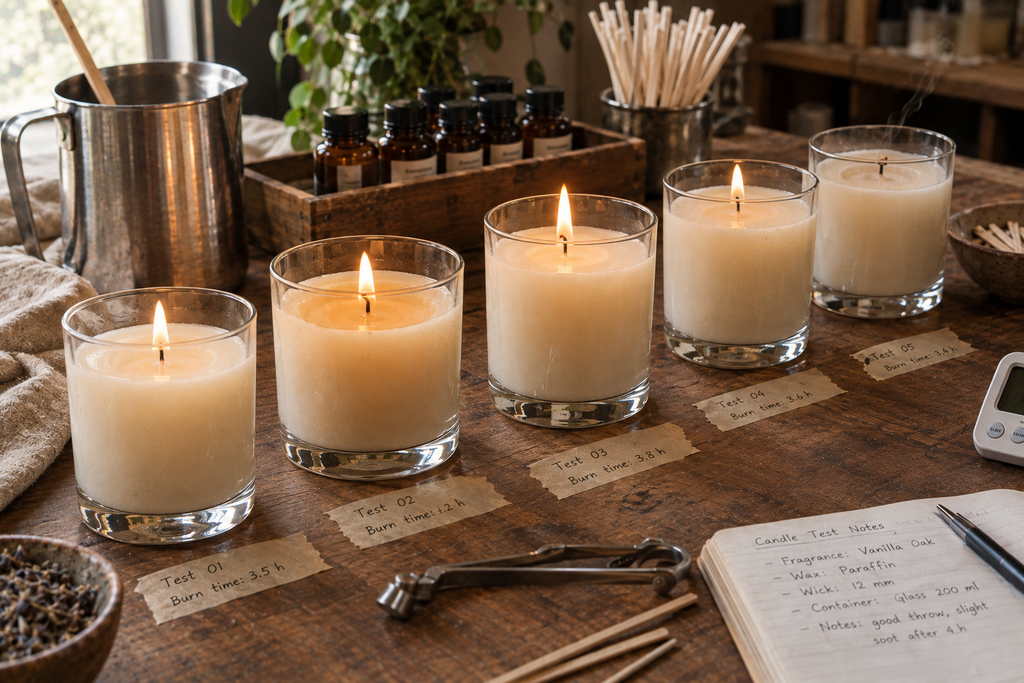
The emissions produced by a burning candle can therefore depend on several factors, including:
- wax formulation
- wick size and type
- fragrance
- dye
- flame size
- candle design
- airflow
- how long the candle has been burning
- whether the candle is burning properly
That means the question isn’t simply:
“Is paraffin toxic?”
It’s more complicated than that.
We need to ask what actually happens when a paraffin candle burns — and whether its emissions are significantly different from those produced by candles made from other common waxes.
That’s where scientific research becomes useful.
What Does Scientific Research Say?
One of the most relevant studies for this discussion is the 2007 Ökometric Wax and Emissions Study, conducted by the Bayreuth Institute of Environmental Research in Germany.
The researchers tested candles made from several major wax types, including paraffin, soy wax, stearin, palm wax and beeswax. They analysed emissions for more than 300 chemicals, including volatile organic compounds (VOCs), polycyclic aromatic hydrocarbons (PAHs), short-chain aldehydes, dioxins and furans.
Under the test conditions, the study found no appreciable differences in overall burning behavior between the tested waxes. The report describes the combustion byproducts as broadly similar in composition and quantity with the measured emissions below the indoor-air standards used for comparison.
That doesn’t mean candles produce absolutely nothing when they burn.
Combustion produces emissions. What the study suggests is that, under its controlled reference conditions, the type of wax alone did not create the dramatic differences that you might expect from some of the claims circulating online.
There is also an important caveat.
The Ökometric study was industry-funded, with support from several candle and wax industry organizations and companies. That doesn’t automatically invalidate the measurements, but it is relevant context when interpreting the study.
In other words, this is useful evidence — but, as with any scientific study, it’s better to look at what it actually tested rather than turning it into a blanket statement about every candle in every situation.
Does Paraffin Produce More Soot Than Other Waxes?
Soot is one of the things that tends to get dragged into the paraffin debate.
The Ökometric study is particularly interesting here because researchers also tested candles with intentionally oversized wicks, designed to produce more soot. When the candles were made to produce significantly more soot, emissions increased compared with the sample candles.
Importantly, this happened with both paraffin and soy candles.
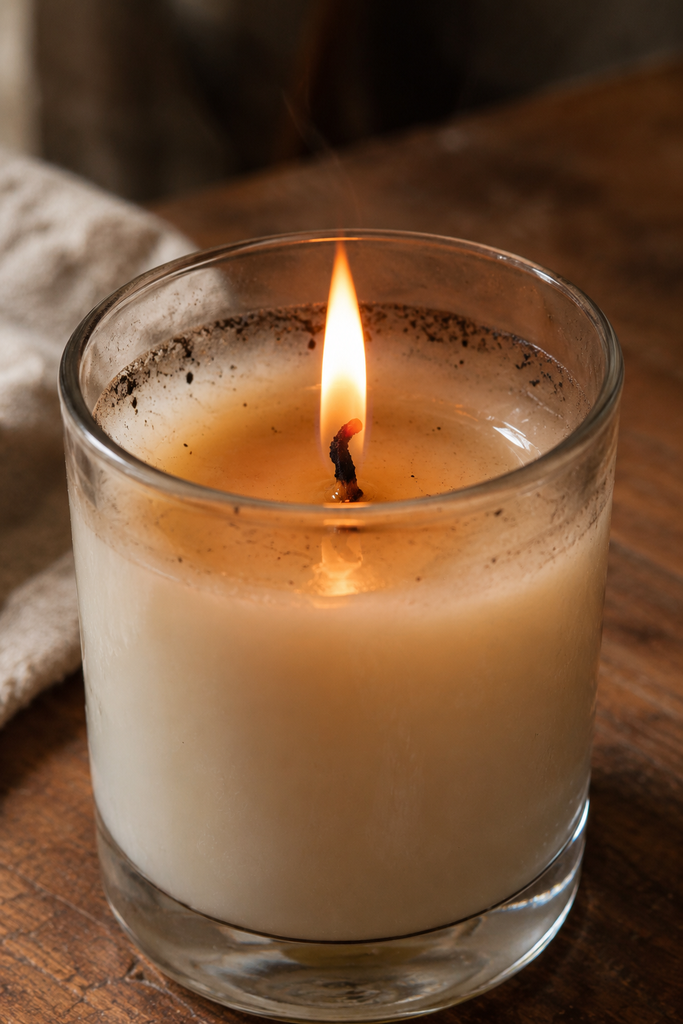
The report therefore gives us a useful practical lesson: burning conditions and wick selection matter enormously.
So the idea that “paraffin equals soot” is a bit too simplistic: a poorly wicked candle, or one with an oversized wick, can produce more soot regardless of whether its wax comes from.
We did gathered opinions from candle makers saying that paraffin is more prone to sooting than other waxes.
That’s one more reason testing your finished product is so important.
Check out our Troubleshooting Guide on Sooting to know more about this phenomenon and help if you are experiencing this problem with your batch of candles.
Is Paraffin Wax Bad for the Environment?
This is where the discussion is less complicated and very straightforward:
Paraffin is petroleum-derived.
Petroleum is a non-renewable resource, and extracting and processing petroleum have environmental impacts.
So, if your priority is choosing renewable materials, paraffin clearly isn’t a good choice like waxes made from renewable agricultural sources are.
At the same time, it’s worth being precise about what paraffin actually is.
Paraffin is one material obtained during petroleum processing. The fact that paraffin exists doesn’t mean crude oil is extracted specifically to make candle wax.
But that doesn’t change the bigger picture:
Paraffin itself is still a petroleum-derived, non-renewable material.
For someone choosing candle wax based primarily on renewable sourcing and bio-based materials, that is a genuine disadvantage.
Is Paraffin Wax Biodegradable?
Some modern fully refined paraffin products are described by their manufacturers as biodegradable under specific composting conditions.
That does not mean you should automatically assume that every paraffin candle is biodegradable in a home compost bin or natural environment.
Even when a particular paraffin product can biodegrade under specific conditions, still that doesn’t make paraffin equivalent to soy wax from a sustainability perspective.
Generally speaking, the biodegradability of a candle after its use depends on many more elements than just wax: for example the additives (like fragrance) present inside and the wick.
Is Paraffin Wax Good for Beginners?
Paraffin has some characteristics that can make it appealing when you’re learning candle making:
- it’s widely available
- there are many formulations to choose from
- it can have strong fragrance performance
- it works well with candle dyes
- there’s a huge amount of candle-making information available about it
But there’s one thing beginners need to understand: you still need to choose the right candle components and test your candles. Always.
Paraffin wax can be beginner-friendly — but it isn’t beginner-proof.
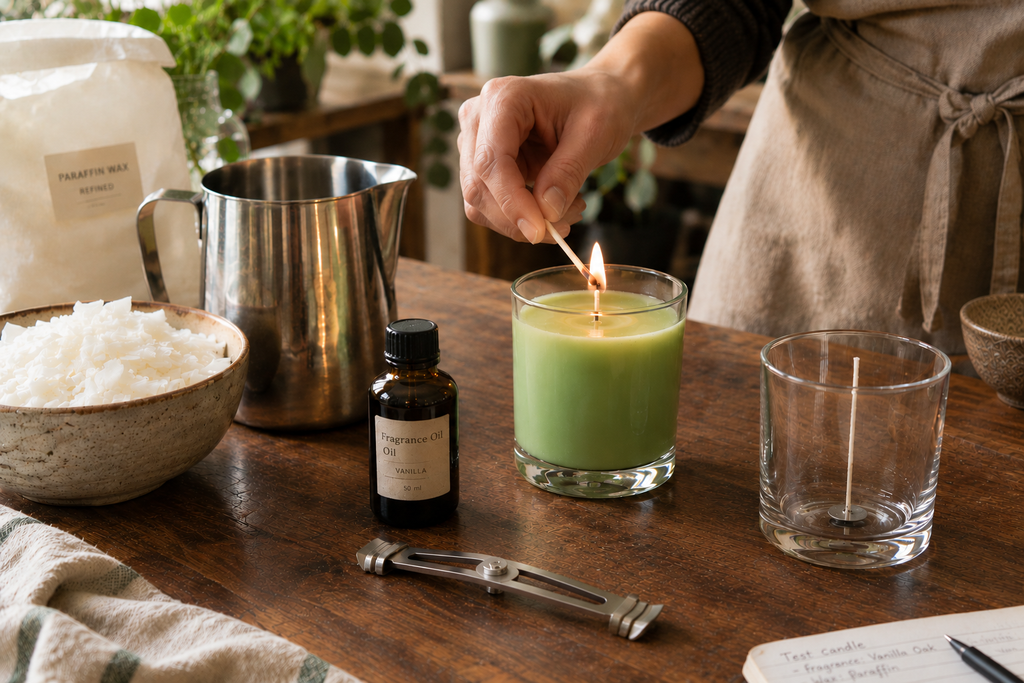
Paraffin Wax: Pros and Cons
Here’s the summary of benefits and disadvantages:
Pros
- Strong fragrance performance
- Can accommodate relatively high fragrance loads
- Excellent color possibilities
- Versatile
- Available in many different grades
- Consistent physical properties within a specific grade
- Works well for molded candles
- Suitable for containers, pillars, melts and other applications
- Widely available in candle making
Cons
- Petroleum-derived
- Made from a non-renewable resource
- Environmental concerns associated with petroleum sourcing
- Prone to shrinking during cooling
- Different grades behave differently
- Not plant-based or renewable
- The controversy around paraffin can make choosing and communicating about it to the customers more complicated
Frequently Asked Questions (FAQ)
Is paraffin wax toxic?
The available research doesn’t support the idea that paraffin candles are automatically toxic simply because paraffin comes from petroleum. The 2007 Ökometric study found broadly similar emissions across the all tested wax types under its laboratory conditions. However, candle emissions depend on the entire burning system, including the wick, fragrance, flame and burning conditions.
Is paraffin wax safe for candles?
Wick size, fragrance, airflow and burning conditions all influence candle emissions and therefore, the safety of the candle. We need to consider the final product as a whole to test its safety, and judge it based on different parameters. There is not a single definitive answer.
Does paraffin wax produce more soot than soy wax?
Not automatically, but can be prone to it. The Ökometric study found that both over-wicked paraffin and soy candles produce increase emissions, This highlights how strongly wick selection and burning conditions can affect emissions.
Does paraffin wax shrink?
Some paraffin formulations can shrink as they cool. The amount varies between waxes, depends on the specific formulation and more so in how the candle is made. Always follow the recommendations for the particular paraffin wax you’re using for your candles.
Is paraffin wax biodegradable?
Some specific modern fully refined paraffin products are described by their manufacturers as biodegradable under controlled composting conditions. Plant-based waxes, though, come from renewable sources, so they have an heads up on sustainability compared to paraffin, which derives from petrol.
Is paraffin wax better than soy wax?
Want to know how paraffin actually compares with soy wax? We covered that in our dedicated Paraffin vs Sow Wax Guide, where we put the two waxes battling head to head, look at their characteristics side by side so you can decide which one fits your candles best.
Final Thoughts
Paraffin wax has been in candle making for almost two centuries, and there’s a reason it hasn’t disappeared.
After all that talk about petroleum, soot, emissions, fragrance loads and biodegradability, you might feel like you’ve just completed a small university course in wax :’)
But hopefully, you’ve also come away with a clearer idea of what paraffin actually is — and why the conversation around it isn’t quite as simple as “good” or “bad.”
Thanks for sticking with us through the paraffin rabbit hole — and we hope this guide helped you understand it a little better!