Beeswax Guide: What It Is, How It’s Made, Its Properties and Uses
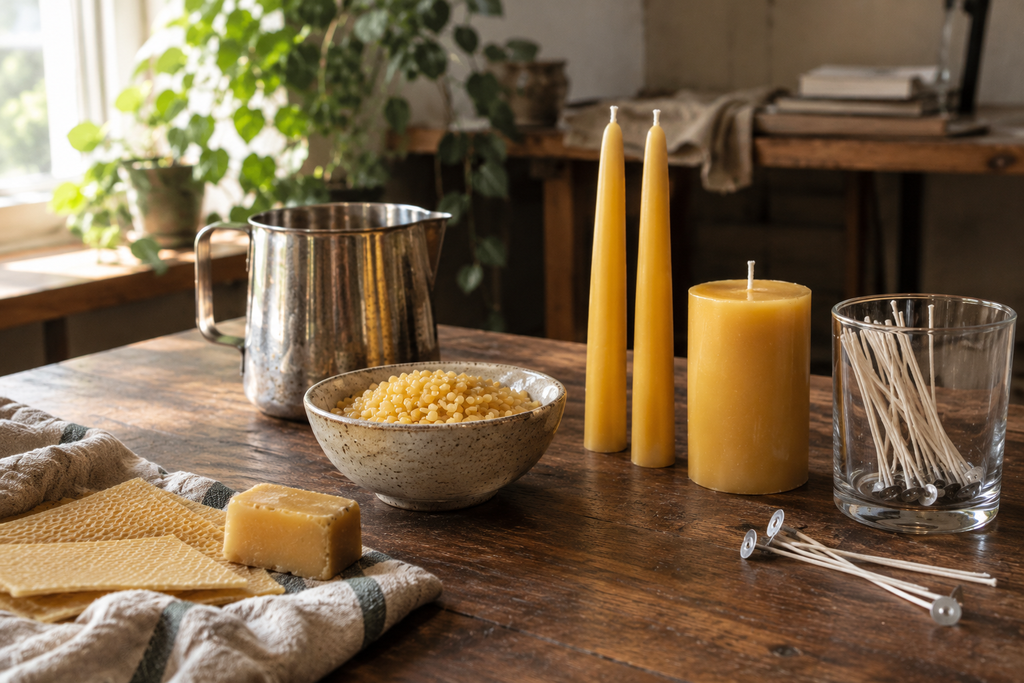
Long before soy or paraffin ever entered the picture, there was beeswax. Bees have been quietly running the original candle factory for thousands of years — no chemists, no factories, just a hive full of very busy workers turning nectar into magic. It’s, hands down, the oldest wax humans have ever burned, and it’s still arguably one of the best.
If you’re new to candle making (or just candle-curious), beeswax can feel a little mysterious. Is it just “fancy honey wax”? Is it actually better than other waxes, or is that just marketing?
That’s exactly what this guide is for. We will cover everything: what beeswax actually is, how it goes from honeycomb to candle-ready blocks, what makes it behave the way it does when it burns, and — most importantly — whether it’s the right pick for your candles.
No assumptions you already know what “wax bloom” means, because years ago we didn’t have a clue either! By the end, you’ll know beeswax well enough to make a confident, informed choice — not just follow a trend.
What is Beeswax?
Beeswax is a natural wax produced by honeybees, used to build the honeycomb inside the hive — the structure that holds their honey, pollen, and young. In short, beeswax is the bees’ own construction material, not a byproduct of honey itself.
Once beekeepers harvest honey, the leftover wax gets cleaned up and turned into the wax you actually buy — usually as blocks, bars, sheets, or pellets, ready to be melted down (or, in the case of sheets, simply wrapped) into candles. We’ll walk through exactly how that happens in the next section.
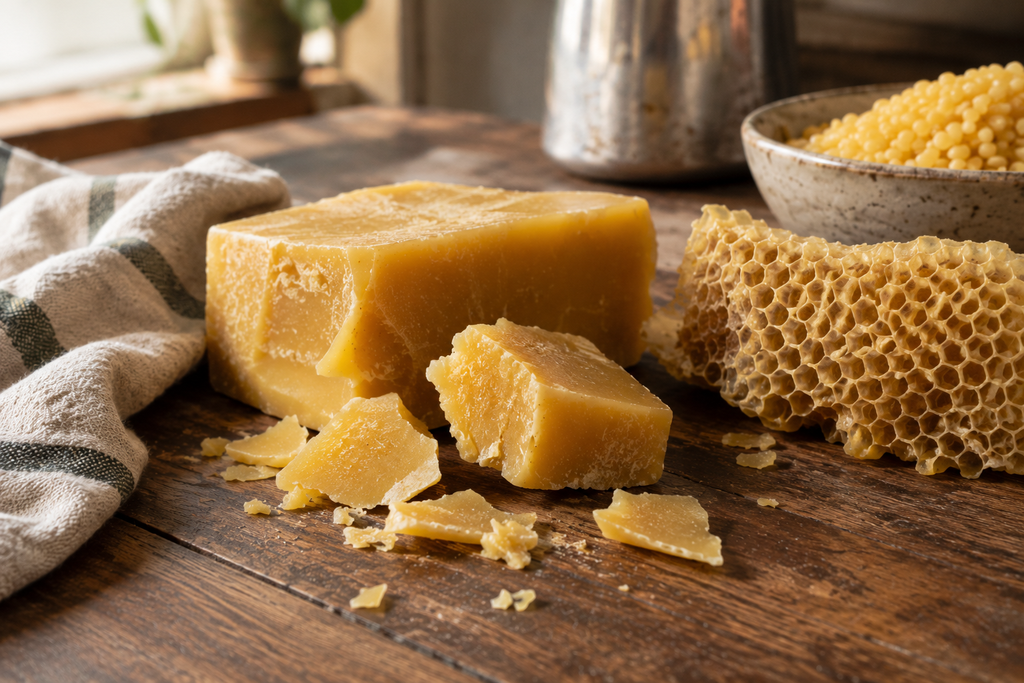
You’ll notice real beeswax almost always carries a warm, golden-honey color and a soft, natural honey scent — a nice bonus for candle makers who want fragrance without adding a single drop of essential oil.
The Different Grades and Types of Beeswax
Here’s what you’ll typically come across when shopping for it:
- Yellow beeswax — Raw or minimally filtered, with its natural color and scent intact. Most popular for candle making.
- White beeswax — Bleached or filtered to remove color and odor, often used in cosmetics or when a cleaner, more neutral look is needed.
- Cosmetic-grade beeswax — Highly filtered and purified, ideal for lip balms, lotions, and skincare.
- Candle-grade beeswax — Filtered enough to remove debris but still keeps its natural color and honey aroma — this is what you want for candle making.
- Organic/certified beeswax — Sourced from hives free of pesticides and synthetic treatments, appealing to eco-conscious makers.
For candle making specifically, yellow, candle-grade beeswax is your best (and most common) starting point.
How Beeswax Is Made
Beeswax isn’t manufactured — it’s secreted. Worker bees produce it through special glands on the underside of their abdomen, releasing it as tiny, nearly clear flakes, which they then chew and shape into the honeycomb themselves. From there, it takes a few more steps before it ends up in your candle-making supplies.
Harvesting
Beekeepers don’t harvest wax on its own — it’s a byproduct of honey harvesting. When honeycomb cells are capped with a thin layer of wax to seal in the honey, that capping has to be sliced off before the honey can be extracted. Beekeepers also periodically replace old, dark comb with fresh foundation, which becomes another source of raw wax.
Processing
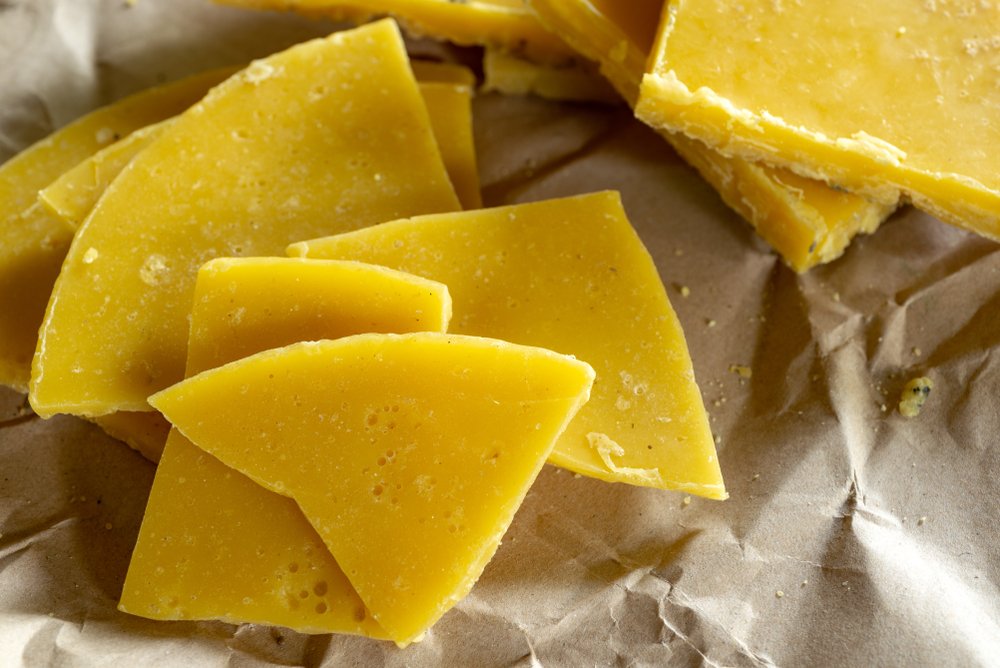
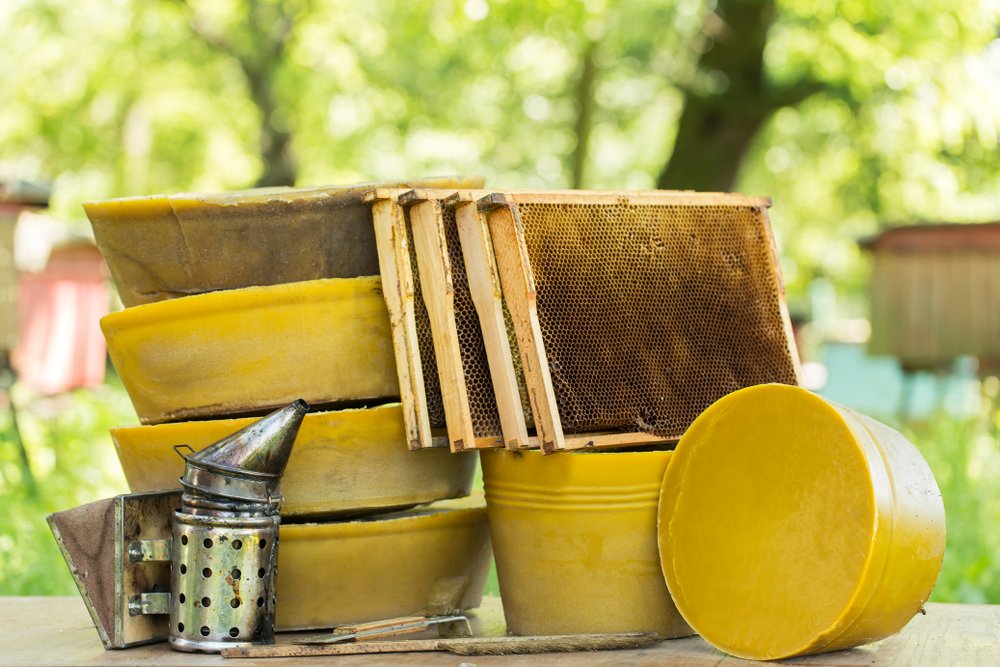
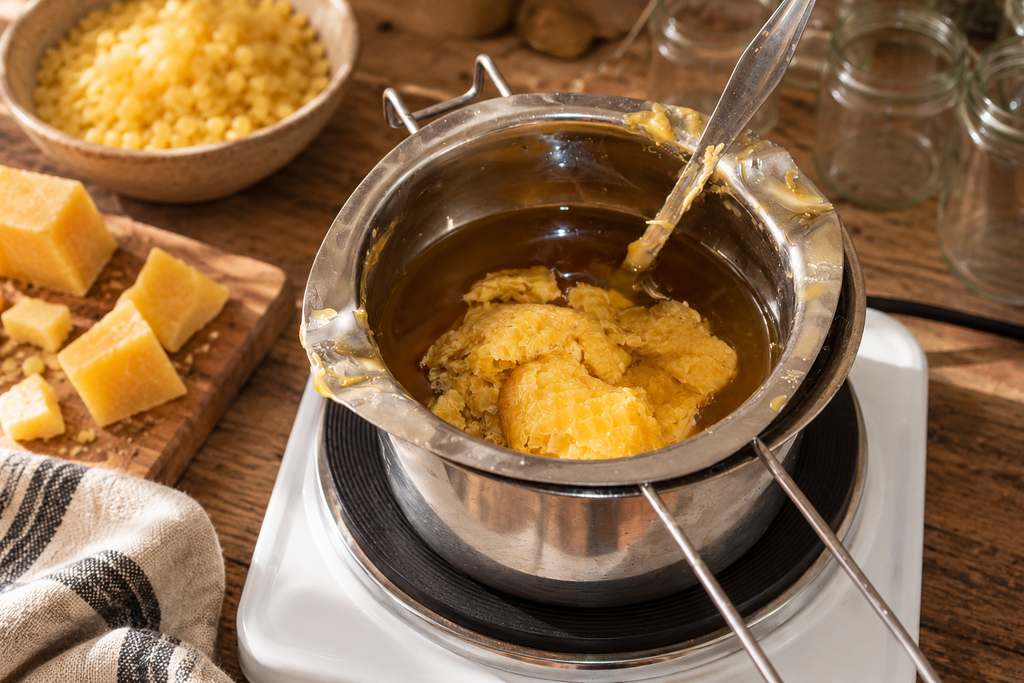
That raw wax — full of propolis, pollen, and bits of debris — gets melted down and filtered, sometimes multiple times, to remove impurities. What’s left is clean, workable beeswax, ready to be poured into molds and cooled into the blocks, bars, or pellets you’ll find for sale.
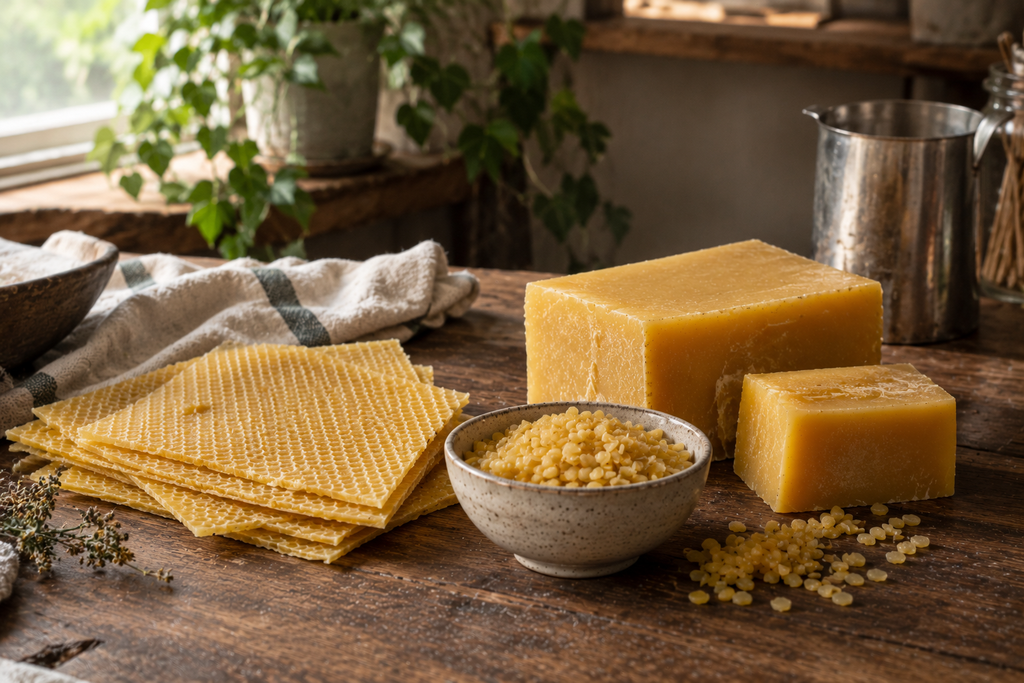
The different forms you’ll come across
This is where it gets interesting for candle makers specifically — you can find beeswax in:
- Blocks, bars, and pellets — the most common form, meant to be melted down and poured, just like soy or paraffin.
- Beeswax sheets — thin, flexible sheets pressed with a honeycomb-like texture, often used for wrapped candles, where you simply wrap the wax around a wick by hand — no melting or pouring required at all. It’s one of the simplest, most beginner-friendly ways to make a candle, and something we’ll get into properly in a future “How to Make Beeswax Candles” guide.
- Raw/unprocessed comb wax — wax still close to its natural state, with more color, scent, and impurities than filtered candle-grade wax.
Understanding these forms matters because it directly affects how you’ll actually use beeswax — melting and pouring is only one path; rolling is another entirely.
Properties of Beeswax & Why It Behaves Differently From Other Waxes
If you’ve ever handled beeswax and thought “huh, this feels different,” you’re right — beeswax has a personality of its own compared to soy or paraffin, and that personality shows up the moment you melt it, pour it, and light it.
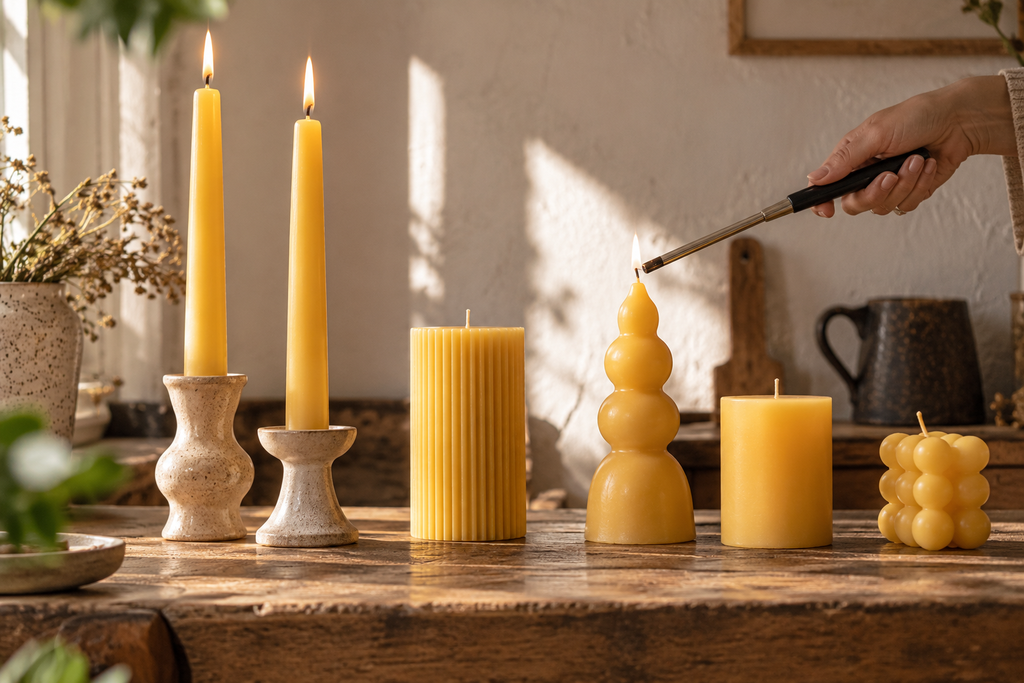
Melting point: Beeswax melts at around 144–149°F (62.2–65°C), noticeably higher than soy wax and most paraffin blends. That higher melting point is part of why beeswax candles hold up so well — they’re more resistant to melting in warm weather and tend to keep their shape better over time.
Hardness and density: Beeswax is the hardest of the common candle waxes. It’s dense, sturdy, and doesn’t soften easily at room temperature, which is exactly why it’s the go-to choice for pillar and taper candles that need to stand on their own without slumping.
Color and scent: Unless it’s been bleached or heavily filtered, beeswax keeps its naturally golden hue and that soft, honey-like aroma we mentioned earlier. It’s subtle — not an overpowering “candy shop” scent — but it’s real, and it’s there without adding a single fragrance oil.
Burn characteristics: Thanks to its density, beeswax burns slowly, which usually means a longer-lasting candle compared to softer waxes. It also tends to burn cleaner, producing less soot than paraffin when the candle is properly wicked.
One quick myth-check before we move on: you may have heard that beeswax candles release negative ions that “purify the air.” It’s a popular claim in candle-making circles, but it’s worth knowing that claims about negative ions are based on anecdotal community discussion rather than verified science — so take it as a nice bonus story, not a proven health benefit.
Despite their clean reputation, burning beeswax candles still involves combustion, which introduces tiny particles and byproducts into the environment rather than purifying it.
Benefits of Beeswax for Candle Making
Once you get past the higher price tag, beeswax makes a pretty compelling case for itself. Here’s what it actually brings to the table:
Natural and non-toxic
Beeswax is about as close to “nothing added” as candle wax gets — no petroleum, no synthetic fillers, just wax that’s been filtered and cleaned. For anyone trying to keep their home (and their candles) free of synthetic ingredients, that simplicity is a big part of the appeal.
Cleaner Burn
Paired with a properly sized wick, beeswax tends to produce noticeably less soot than paraffin, meaning less black residue creeping up your jar, walls, or ceiling over time. It’s not a soot-free guarantee — wick size and trimming still matter — but the difference is real.
Long & Slow Burn Time
That density we talked about earlier isn’t just for show — it means a beeswax candle can genuinely outlast a soy or paraffin candle of the same size.
Factor that into cost-per-hour of burn time, and beeswax starts closing the gap on its higher upfront price.
Naturally Scented
You get a soft, honey-like fragrance built right in, no essential oils or fragrance blends required. It’s a simple, no-fuss way to add a little warmth to a room. The scent is subtle rather than overpowering, making it especially nice for cozy spaces.
And while it may become less noticeable over time, the natural aroma is part of what makes beeswax candles so appealing.
Renewable — with a Caveat worth knowing
Beeswax is a byproduct of an industry that already exists: beekeeping. It’s biodegradable and leaves no synthetic residue behind, which is where its “eco-conscious” reputation comes from.
That said, it’s still an animal byproduct, not a vegan material, and how sustainably it’s harvested depends entirely on the beekeeper’s practices — so if that matters to you, it’s worth choosing a supplier that’s transparent about their process.
Sturdy and Shape-holding
Its hardness makes it ideal for pillar and taper candles that need to hold their form without sagging or softening at room temperature. Once cooled and set, the wax keeps its shape well, giving candles a solid, long-lasting feel.
Put together, it’s easy to see why beeswax has stuck around for thousands of years — not because other waxes vanished, but because beeswax has simply kept earning its spot on the shelf, holding its own against newer options.
If you’re curious how it actually stacks up, our soy wax and paraffin wax guides break both down in detail.
Drawbacks & Challenges of Beeswax
As much as we’ve been singing beeswax’s praises, let’s be honest for a second: no wax is perfect, and beeswax comes with its own list of quirks worth knowing before you commit a whole batch of candles to it.
It’s the Priciest Option
Beeswax typically costs more per pound than soy or paraffin, sometimes significantly more depending on grade and source. Part of that comes down to supply — bees can only produce so much, so fast — and part of it comes from rising demand for “natural” waxes in general.
If you’re working with a tight budget, or trying to keep retail prices competitive, this is usually the first wall beginners hit.
It’s Harder to Work with
That high melting point we praised earlier as a strength has a flip side: beeswax needs higher pouring temperatures, cools and hardens faster than softer waxes, and can be more prone to cracking or uneven surfaces if your temperature control isn’t dialed in.
Ironically, a lot of beginners find beeswax less “beginner-friendly” than soy.
Limited Color Options
Beeswax’s natural golden tint doesn’t disappear just because you’ve added dye — it blends with whatever color you’re using, often shifting or muting the final result.
True whites and soft pastels are especially hard to pull off unless you start with bleached white beeswax, which trades away some of that natural charm to get there.
It can develop “Bloom”
Beeswax candles are prone to a natural, completely harmless filminess on their surface known as bloom. We’ll get into exactly what causes it (and why it’s nothing to worry about) a little further down.
Sourcing isn’t always Consistent
Since beeswax comes from real hives rather than a standardized formula, its color, scent, and even melting point can shift batch to batch depending on the bees, the region, and the flowers they were working.
It’s part of what makes beeswax feel special — but it also means less predictability than a mass-produced wax.
None of this makes beeswax a bad choice — it just means it asks for a bit more patience, and a bit more budget, than some of its competitors.
Think of it as wax with a little attitude: worth the effort, but it never lets you forget who’s really in charge.
What Is “Bloom”? (Should You Worry About It?)
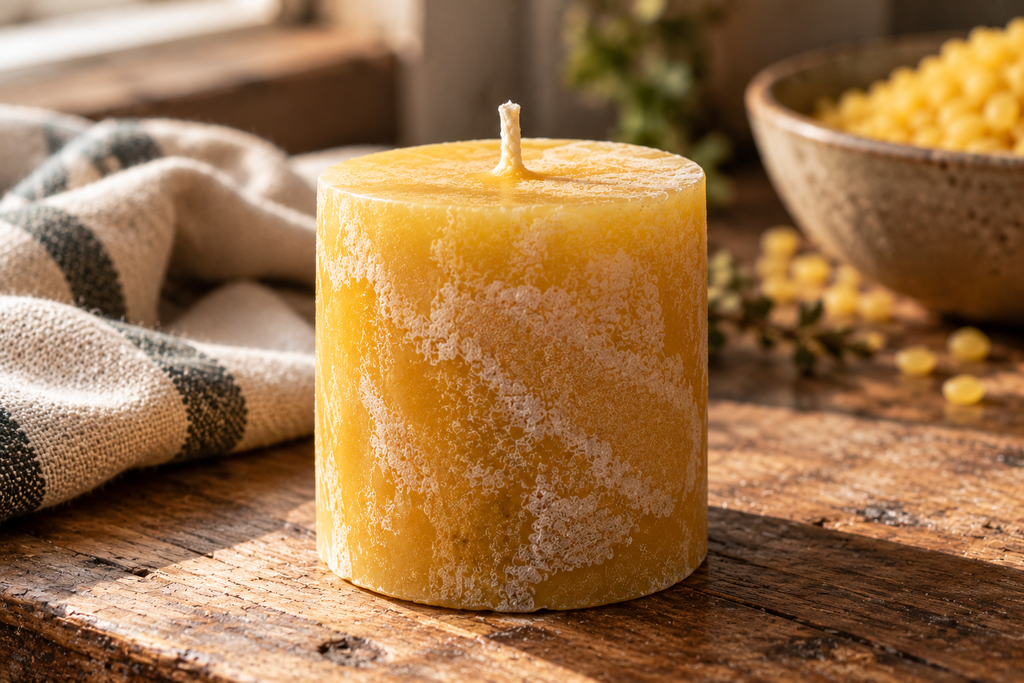
If you’ve ever pulled a beeswax candle out of storage and found it looking a little dusty or frosted — like it aged ten years overnight — don’t panic. What you’re seeing is called bloom, and it’s one of the most misunderstood — and harmless things that happen to beeswax candles.
Bloom shows up as a soft, whitish or grayish film that forms on the surface of beeswax over time. It’s most noticeable on darker, more natural yellow beeswax, where the contrast makes it easy to spot. It can look like dust, frost, or even mold at first glance — which is exactly why it worries so many beginners.
What Actually Causes it?
Bloom happens because beeswax naturally contains fatty acids that rise to the surface as the wax cools and ages, crystallizing into that pale film. Temperature changes tend to speed this up — a beeswax candle that’s been through a few warm-to-cool cycles (say, sitting near a window, or stored in a garage) is more likely to bloom than one kept in a stable environment.
Is it Harmful?
Not even a little. Bloom doesn’t affect how the candle burns, how it smells, or how safe it is to use. It’s a purely cosmetic, completely natural reaction — honestly, some candle makers consider it proof that they’re holding real, unadulterated beeswax rather than a heavily processed blend.
Can you Get Rid of It?
If the frosted look isn’t your thing, bloom is easy to buff away. A soft cloth and a little friction (or a very gentle pass with a hairdryer on low heat) will melt it back into the surface, restoring that rich golden shine.
Again, some makers even lean into it, treating bloom as a natural, rustic feature rather than a flaw to fix.
So if your beeswax candle starts looking a bit frosty with age, don’t toss it, and don’t panic — just give it a little buff, and it’ll be back to looking its best in seconds.
Beeswax vs. Soy Wax vs. Paraffin Wax
By now you know beeswax pretty well on its own — but the real question most beginners are actually asking is “okay, but which wax should I use?” So let’s put all three side by side.
| Beeswax | Soy Wax | Paraffin Wax | |
| Melting point | High (~62–65°C / 144–149°F) | Low (~49–68°C / 120–155°F) | Varies widely (~46–68°C / 115–154°F) |
| Scent throw | Mild, natural honey scent; can mute added fragrance | Moderate scent throw | Strong scent throw |
| Cost | Highest | Mid-range | Lowest |
| Burn time | Longest, slowest burn | Moderate | Fastest burn, depending on blend |
| Soot/clean burn | Low soot with proper wick | Low soot | Higher soot potential |
| Eco-profile | Natural, renewable, but not vegan | Plant-based, biodegradable | Petroleum-based, non-renewable |
| Ease of use for beginners | More demanding (temperature-sensitive) | Beginner-friendly | Beginner-friendly |
| Best for | Pillars, tapers, natural/unscented candles | Container candles, strong scent throw | Budget candles, strong fragrance |
A few honest takeaways from the table:
- If you want strong, room-filling fragrance, beeswax is probably not your first pick — that’s paraffin’s specialty, and part of why it’s still so widely used despite its petroleum origins.
- If you’re chasing an easy, forgiving beginner experience, soy wax tends to be the gentler learning curve, with more flexibility for dyes and fragrance without fighting the wax itself.
- If what you’re after is natural, long-burning, and low-maintenance scent, beeswax earns its higher price tag back over time.
There’s no universally “best” wax here — just the best wax for what you’re making. If you want a more detailed head to head waxes comparisons, we made two in depth articles: Beeswax vs Paraffin wax and Beeswax vs Sow wax. Should you need more informations before making your decision, we got you covered!
Other Common Uses of Beeswax
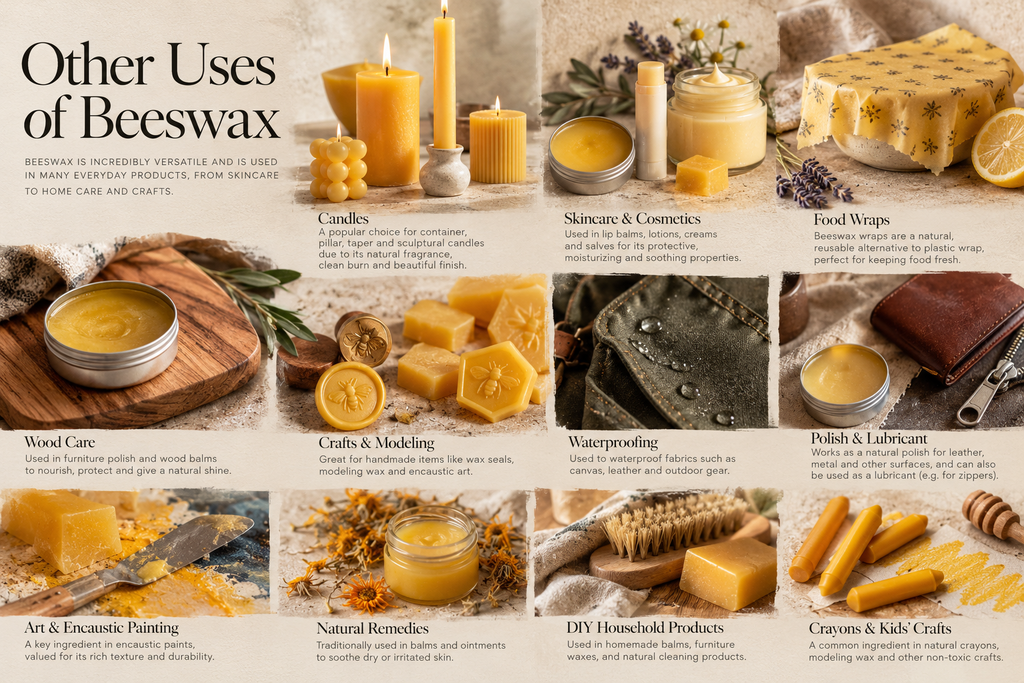
Candles get most of the spotlight, but they’re really just one use for beeswax. Humans have relied on this material for thousands of years, long before anyone thought to pour it into a jar and add a wick. Here’s where else you’ll find it:
1. Cosmetics & Skincare
Beeswax is a staple ingredient in lip balms, lotions, salves, and creams, where it acts as a natural thickener and protective barrier for the skin. It locks in moisture without clogging pores, which is exactly why it’s survived centuries of trends in an industry that reinvents itself every year.
2. Food Wraps
Beeswax wraps — cotton fabric infused with beeswax, often blended with tree resin and oil — have become a popular reusable alternative to plastic wrap. The wax creates a pliable, slightly tacky seal that keeps food fresh, and it can be rinsed and reused for months.
3. Wood & Leather care
Mixed with oils, beeswax makes an excellent natural polish for wood furniture and leather goods, conditioning the material while adding a protective, water-resistant layer. It’s the same logic that made it useful centuries ago for waterproofing thread, rope, and even boots.
4. Art & Encaustic Painting
Encaustic painting — an ancient technique dating back to Greek and Roman times — uses heated beeswax mixed with pigment as the actual paint medium. Artists layer and shape the wax while it’s workable, creating texture that’s simply impossible to replicate with traditional paint.
5. Metal Casting
In jewelry making and metalwork, beeswax is often used in the “lost-wax casting” process, where a wax model is carved, coated in a mold, then melted away and replaced with molten metal. It’s a technique that’s been refined for thousands of years and is still a standard practice today.
6. Historical & Everyday uses
Beyond the categories above, beeswax has shown up throughout history as a sealant for letters and documents, a lubricant for tools and machinery, a component in traditional medicine, and even as an early chewing gum (the ancient Greeks reportedly chewed beeswax mixed with resin).
With this bigger picture in mind, let’s bring it back to candles specifically: is beeswax actually the right pick for what you want to make?
Is Beeswax the Right Choice for Your Candles?
So, after all that — is beeswax actually the one for you? Here’s the honest breakdown.
Pros
- You want a naturally scented candle without relying on fragrance oils
- You’re making pillar or taper candles that need to hold their shape
- You care about using a natural, minimally processed material
- You’re fine with a higher price point in exchange for a longer burn time
- You’re comfortable with (or interested in) a slightly steeper learning curve
Cons
- You want strong, customizable fragrance throw — paraffin or soy will get you there more easily
- You’re working with a tight budget or producing candles at a larger scale
- You want full control over color and shades, including true whites or pastels
- You’re just starting out and want the most forgiving wax to learn on
How to Store and Handle Beeswax
Good news: beeswax is about as low-maintenance to store as materials get, which is one more point in its favor once you’ve already invested in it.
Storage conditions
Keep beeswax in a cool, dry place, away from direct sunlight and heat sources. Extreme heat can cause it to soften or warp, while prolonged sun exposure can fade its natural golden color over time. A sealed container or bag also helps keep dust and debris off, since beeswax can attract small particles if left uncovered.
Shelf life
Here’s the best part: beeswax essentially doesn’t expire. Unlike oils or butters, it’s not prone to going rancid, so properly stored beeswax can last for years — even decades — without losing its core properties. If anything changes in appearance over time, it’s far more likely to be bloom (remember that harmless film from earlier) than any sign of it going bad.
Re-melting
Beeswax can be melted down and re-melted multiple times without significantly affecting its performance, which makes it fairly forgiving if a pour doesn’t go as planned. The one thing to keep in mind: repeated melting can gradually soften its natural honey scent, so if you’re relying on beeswax’s aroma alone, it’s worth minimizing how many times you remelt the same batch.
Frequently Asked Questions (FAQ)
Is beeswax vegan?
No. Beeswax is an animal byproduct, produced by honeybees, so it doesn’t fit a vegan lifestyle even when harvested without harming the colony. It’s considered vegetarian, but not vegan — if that distinction matters to you, look for suppliers who are transparent about their harvesting practices.
Does beeswax expire or go bad?
Not really. Properly stored beeswax can last for years, even decades, without losing its core properties. If it starts looking dusty or cloudy with age, that’s almost always harmless bloom, not decay.
Can you mix beeswax with soy or paraffin wax?
Yes, and many candle makers do exactly that. Blending beeswax with soy or paraffin can balance out its higher cost and tricky melting point while still keeping some of its natural benefits, like a cleaner burn or subtle honey scent.
Why does my beeswax candle look frosty or cloudy?
That’s “bloom” — a natural, harmless film that forms as fatty acids in the wax rise to the surface over time. It doesn’t affect how the candle burns or smells, and it can easily be buffed away with a soft cloth if you’d rather not see it.
Can you add fragrance oils to beeswax candles?
You can, but beeswax’s natural honey scent can compete with or mute added fragrances, so scent throw is often weaker than with soy or paraffin. Many candle makers choose to let beeswax’s natural aroma stand on its own, but trying has never hurt no one.
Is beeswax safe for people with allergies?
Beeswax is generally well-tolerated. Being it is bee-derived product, people with bee or pollen allergies should check with a doctor before using it, especially with skincare applications. For candles specifically, reactions are rare, but it’s worth knowing if you have a sensitivity.
Final Thoughts
So there you have it — beeswax, fully demystified: bloom, melting points, sheets vs. pellets, and even its oddly complicated relationship with veganism.
Who knew something a bee makes while just going about its day could come with this much to unpack? And yet here we are, taking notes from an insect that’s apparently better at construction and chemistry than most of us.
Thanks for sticking with us through the whole hive-to-candle journey — we hope this guide left you a little more confident — and a little more impressed by bees than you were before.